


Download Free EMC D-PST-DY-23 Exam Questions & Answer
Online VALID D-PST-DY-23 Exam Dumps File Instantly
NEW QUESTION # 88
What is the maximum supported PowerStore file system size in TB?
- A. 0
- B. 1
- C. 2
- D. 3
Answer: A
NEW QUESTION # 89
Refer to the Exhibit.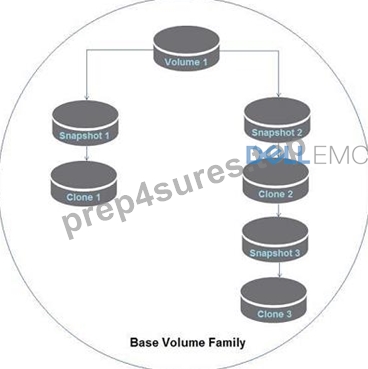
What happens to the parent resource of thin clone 3 if thin clone 2 is deleted?
- A. Snapshot 3 becomes the parent
- B. Thin clone 3 becomes parent
- C. Thin clone 3 has an empty parent
- D. Thin clone 1 becomes parent
Answer: A
NEW QUESTION # 90 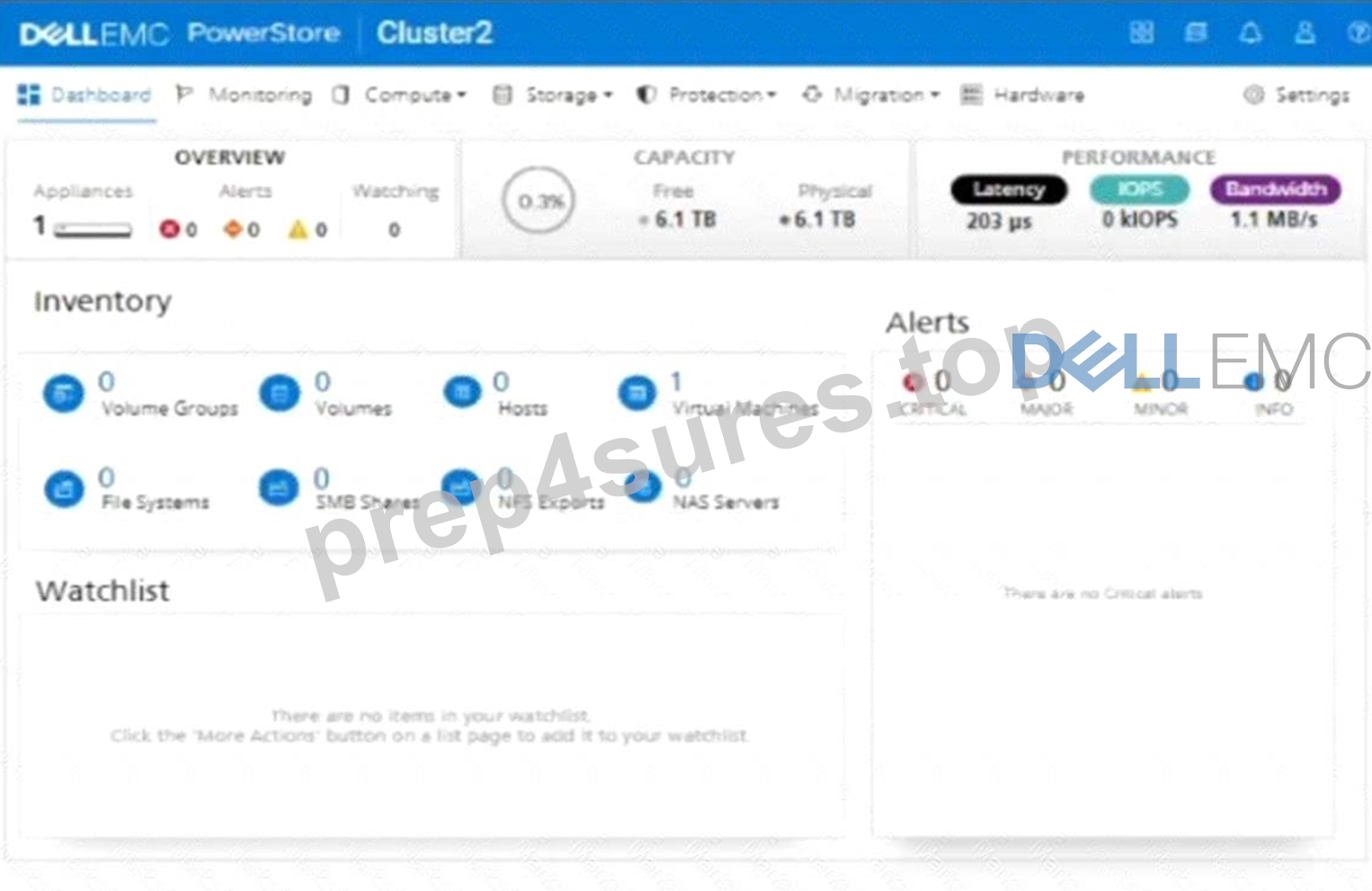
An administrator is setting up a new ESXi cluster using NVMe over TCP. The administrator is given the following parameters:
Volume Details
Name: nvme-ds-01
Category: Virtualization
Application: Containers/Kubernetes
Volume Performance Policy: High
Size: 2 TB
Host Details
Name: ESXi-01
Initiator Type: NVMe
Host Mappings: NVMe
Use the simulator to add the host and the volume and give the host access to the volume using the above parameters.
When you have finished, continue to the next question.
Answer:
Explanation:
See the steps in Explanation.
Explanation:
1. On the simulator, click on theStoragetab on the left sidebar. Then click on theVolumessubtab. You will see a list of existing volumes on the cluster.
2. To create a new volume, click on theCreatebutton on the top right corner. A dialog box will appear where you can enter the volume details.
3. Enter the name of the volume asnvme-ds-01. Select the category asVirtualizationand the application asContainers/Kubernetes. These are optional fields that help you organize and identify your volumes.
4. Select the volume performance policy asHigh. This will optimize the volume for high performance and low latency. You can also customize the policy by clicking on theAdvancedbutton and adjusting the settings.
5. Enter the size of the volume as2 TB. You can also enable thin provisioning, compression, and deduplication if you want to save space and improve efficiency. Click on theCreatebutton to create the volume.
6. You will see a confirmation message that the volume has been created successfully. Click on theClosebutton to exit the dialog box. You will see the new volume in the list of volumes.
7. To add a new host, click on theHostssubtab on the left sidebar. You will see a list of existing hosts on the cluster.
8. To create a new host, click on theCreatebutton on the top right corner. A dialog box will appear where you can enter the host details.
9. Enter the name of the host asESXi-01. Select the initiator type asNVMe. This will enable the host to use the NVMe over TCP protocol to access the volumes.
10. To add the host mappings, click on theAdd Mappingbutton. A dialog box will appear where you can select the volume and the access type.
11. Select the volumenvme-ds-01from the drop-down menu. Select the access type asNVMe. This will map the volume to the host using the NVMe over TCP protocol. Click on theAddbutton to add the mapping.
12. You will see the mapping in the list of host mappings. You can add more mappings if you want to map more volumes to the host. Click on theCreatebutton to create the host.
13. You will see a confirmation message that the host has been created successfully. Click on theClosebutton to exit the dialog box. You will see the new host in the list of hosts.
14. You have completed the task of adding the host and the volume and giving the host access to the volume using the NVMe over TCP protocol. You can verify the configuration by clicking on the host or the volume and checking the details.
NEW QUESTION # 91
Which two migration tasks are configured during a non-disruptive import in PowerStore? (Choose two.)
- A. Refresh Hosts
- B. Start Copy
- C. Refresh Volumes
- D. Host Cleanup
Answer: B,C
NEW QUESTION # 92
DRAG DROP
Place the steps in the correct order to configure vCenter server to use PowerStore to support virtual volumes.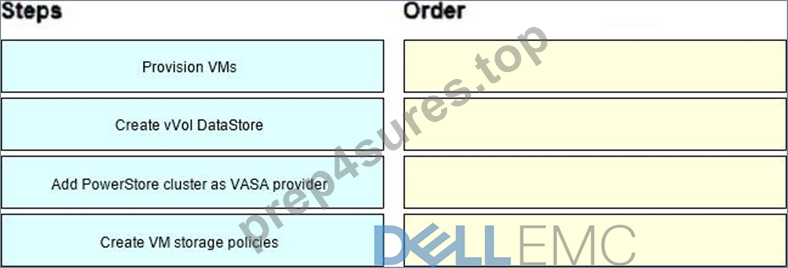
Answer:
Explanation: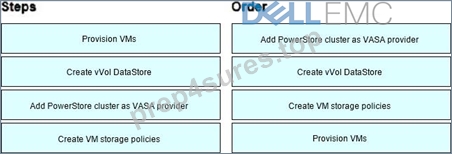
NEW QUESTION # 93
Which three configurations are supported on the file system inPowerStore? (Choose three.)
- A. Create thin clones
- B. Configure CEPA
- C. Set up NDMP backup
- D. Move between NAS servers
- E. Modify name
Answer: A,C,E
NEW QUESTION # 94
A Storage administrator configured a read-only NFS export for a specific set of UNIX hosts and added the IP addresses to the host access list. There have been reports that unauthorized hosts are able to access the export.
What is the required setting to correct this problem?
- A. Default access: no access
- B. Minimum security: Kerberos
- C. Default access: read only
- D. Minimum Security: sys
Answer: A
NEW QUESTION # 95
A PowerStore administrator is creating a host group.
Which two protocol types can be selected for a new host group? (Choose two.)
- A. NVMe/TCP
- B. iSCSI
- C. InfiniBand
- D. FC
Answer: B,D
Explanation:
Host Groups and Supported Protocols in PowerStore
Host Groups: Host groups in PowerStore allow you to group multiple hosts together for easier management and access control. When you create a host group, you specify the protocol that the hosts in that group will use to connect to the PowerStore appliance.
Supported Protocols: PowerStore supports several protocols for host connectivity, but when creating a host group, you can choose from these two:
iSCSI: A widely used IP-based storage networking protocol.
FC (Fibre Channel): A high-speed network technology primarily used for storage networking.
Why other options are incorrect:
A . InfiniBand: While PowerStore supports InfiniBand for NVMe over Fabrics (NVMe-oF), it's not a selectable option when creating a host group.
C . NVMe/TCP: Similar to InfiniBand, NVMe/TCP is supported for NVMe-oF, but it's not a protocol choice during host group creation.
Key Considerations for Host Groups
Single Protocol per Host Group: A host group can only use one protocol. All hosts within the group must use the same protocol (either iSCSI or FC) to connect to PowerStore.
Host Mapping: After creating a host group, you can map volumes to the group, granting access to all hosts within that group.
Dell PowerStore Reference
PowerStore: Hosts and Host Groups: This section in the PowerStore documentation provides detailed information about creating and managing host groups, including the supported protocols.
NEW QUESTION # 96 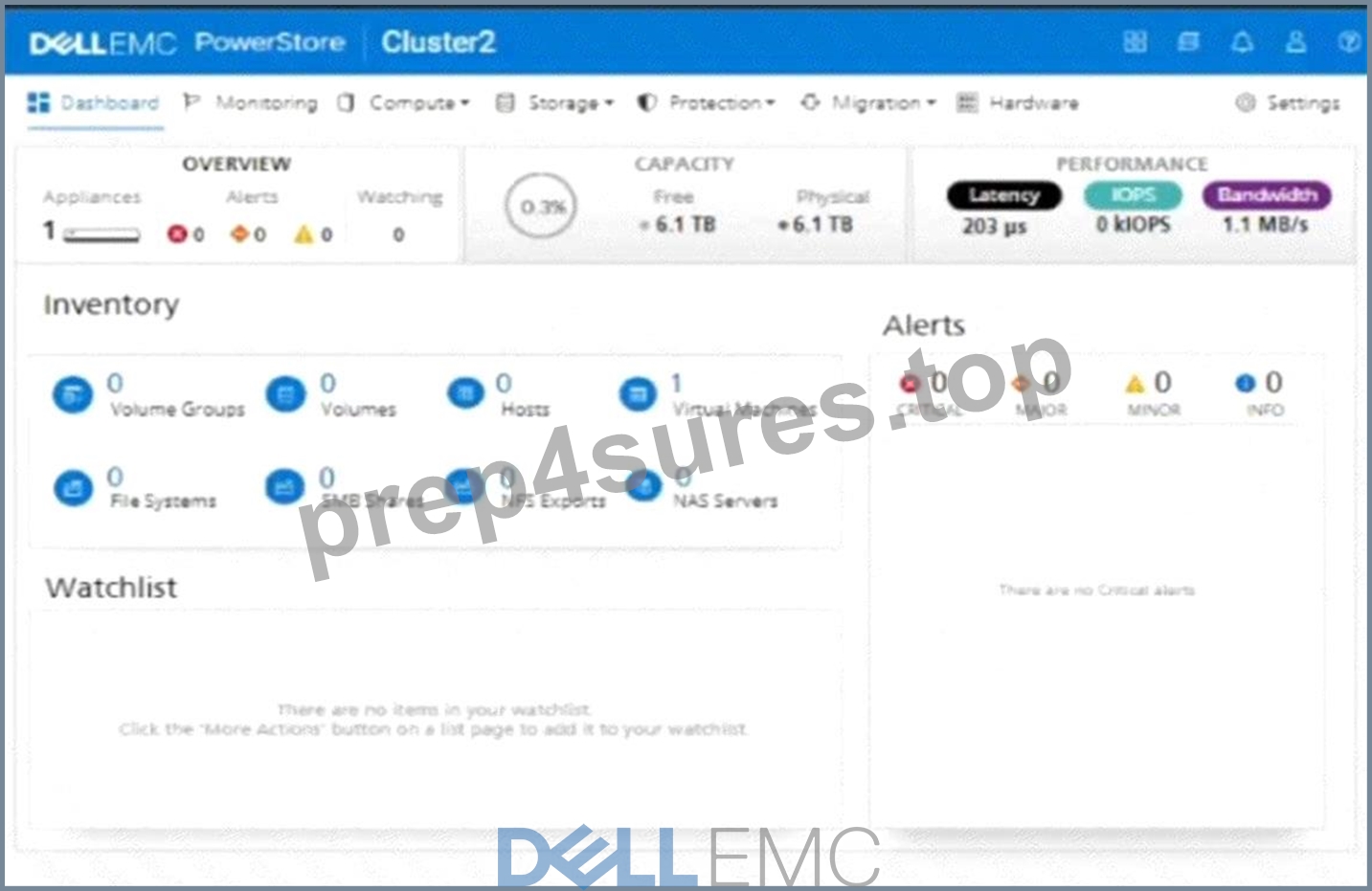
An administrator is setting up a new ESXi cluster using NVMe over TCP. The administrator is given the following parameters:
Volume Details
Name: nvme-ds-01
Category: Virtualization
Application: Containers/Kubernetes
Volume Performance Policy: High
Size: 2 TB
Host Details
Name: ESXi-01
Initiator Type: NVMe
Host Mappings: NVMe
Use the simulator to add the host and the volume and give the host access to the volume using the above parameters.
When you have finished, continue to the next question.
Answer:
Explanation:
See the steps in Explanation.
Explanation:
1. On the simulator, click on theStoragetab on the left sidebar. Then click on theVolumessubtab. You will see a list of existing volumes on the cluster.
2. To create a new volume, click on theCreatebutton on the top right corner. A dialog box will appear where you can enter the volume details.
3. Enter the name of the volume asnvme-ds-01. Select the category asVirtualizationand the application asContainers/Kubernetes. These are optional fields that help you organize and identify your volumes.
4. Select the volume performance policy asHigh. This will optimize the volume for high performance and low latency. You can also customize the policy by clicking on theAdvancedbutton and adjusting the settings.
5. Enter the size of the volume as2 TB. You can also enable thin provisioning, compression, and deduplication if you want to save space and improve efficiency. Click on theCreatebutton to create the volume.
6. You will see a confirmation message that the volume has been created successfully. Click on theClosebutton to exit the dialog box. You will see the new volume in the list of volumes.
7. To add a new host, click on theHostssubtab on the left sidebar. You will see a list of existing hosts on the cluster.
8. To create a new host, click on theCreatebutton on the top right corner. A dialog box will appear where you can enter the host details.
9. Enter the name of the host asESXi-01. Select the initiator type asNVMe. This will enable the host to use the NVMe over TCP protocol to access the volumes.
10. To add the host mappings, click on theAdd Mappingbutton. A dialog box will appear where you can select the volume and the access type.
11. Select the volumenvme-ds-01from the drop-down menu. Select the access type asNVMe. This will map the volume to the host using the NVMe over TCP protocol. Click on theAddbutton to add the mapping.
12. You will see the mapping in the list of host mappings. You can add more mappings if you want to map more volumes to the host. Click on theCreatebutton to create the host.
13. You will see a confirmation message that the host has been created successfully. Click on theClosebutton to exit the dialog box. You will see the new host in the list of hosts.
14. You have completed the task of adding the host and the volume and giving the host access to the volume using the NVMe over TCP protocol. You can verify the configuration by clicking on the host or the volume and checking the details.
NEW QUESTION # 97
When does a Protection Pokey have to be removed from PowerStore storage resource? (Choose two.)
- A. Before refreshing a Storage Resources from a Clone
- B. Before expanding volume capacity
- C. Before deleting a volume
- D. Before moving the volume to a protected volume group
Answer: A,C
NEW QUESTION # 98
What role does a NAS server play in PowerStore file provisioning?
- A. Creating virtual machines
- B. Allocating LUNs
- C. Managing object storage
- D. Hosting shared file systems
Answer: D
NEW QUESTION # 99
SIMULATION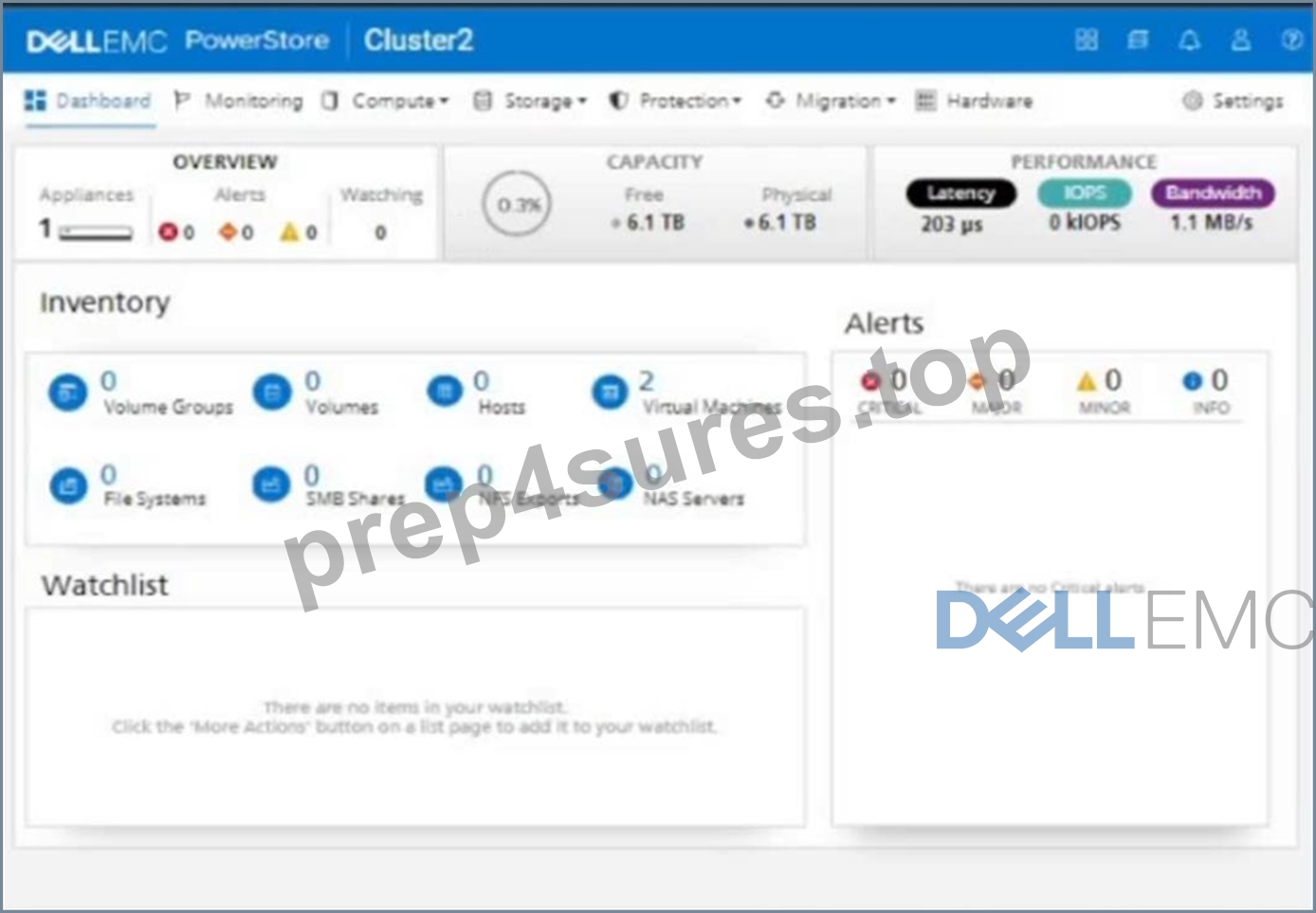
Use the simulator to assign a protection policy to the virtual machine "VM1". Use the following settings:
Snapshots on Monday through Friday at 10:00 PM Eastern Time
Retention of 10 days
When you have finished, continue to the next question.
Answer:
Explanation:
See the Explanation below for complete solution
Explanation:
Navigate to the virtual machine management section where VMs are listed, usually under the "Compute" or "VM" section.
Locate "VM1" from the list of virtual machines.
Access the settings or properties of "VM1".
Look for the "Protection" or "Protection Policies" section within the VM settings.
Select the option to create a new policy or assign an existing one.
In the policy settings, configure the snapshot schedule:
Set the frequency to weekly on Monday, Tuesday, Wednesday, Thursday, and Friday.
Set the time to 10:00 PM Eastern Time.
Configure the retention period for the snapshots to be 10 days.
Save the policy and ensure it is correctly associated with "VM1".
NEW QUESTION # 100
Place the steps in the correct order to configure vCenter server to use PowerStore to support virtual volumes.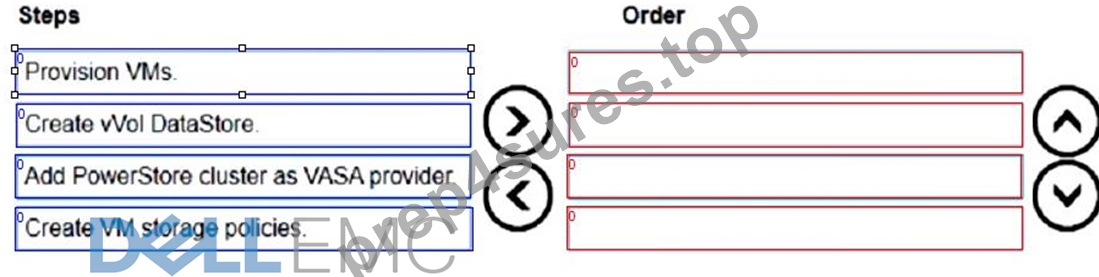
Answer:
Explanation: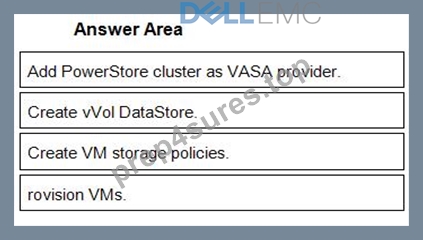
1 - Add PowerStore cluster as VASA provider.
2 - Create vVol DataStore.
3 - Create VM storage policies.
4 - rovision VMs.
NEW QUESTION # 101
SIMULATION
An administrator received a request to provision a new test dev volume.
Use the simulator to provision a volume of 50 GB for their application team. Use a category of Other. The volume performance must not impact the production I/O when the system is heavily loaded.
When you have finished continue to the next question.
Answer:
Explanation:
See explanation below.
Explanation: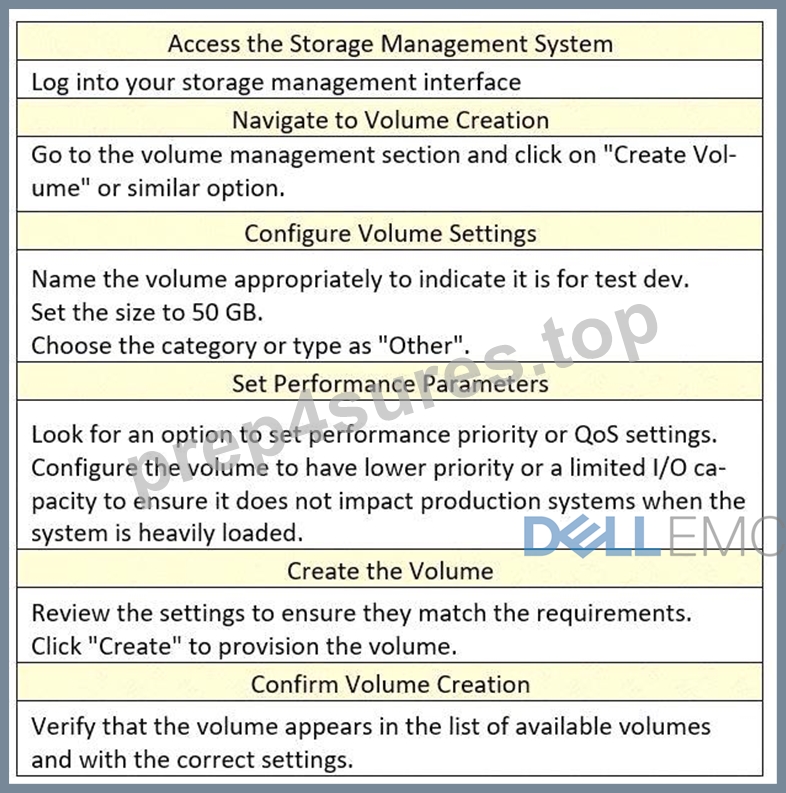
NEW QUESTION # 102
A customer wants to add capacity to their PowerStore 5000T. The system is populated with 6 NVMe SCM 750 GB drives.
What is the maximum number and type of drives that can be added to the base enclosure?
- A. 17 NVMe SSD
- B. 15 NVMe SCM
- C. 17 NVMe SCM
- D. 15 NVMe SSD
Answer: B
NEW QUESTION # 103
What is required for metro connectivity in a vSphere environment?
- A. Host is located in remote site
- B. Host is located in local site
- C. Stretched vSphere cluster
- D. VMware SRM is enabled.
Answer: C
NEW QUESTION # 104
Which network does the PowerStore Discovery Utility use to identify unconfigured appliances?
- A. ICM
- B. Management
- C. IDN
- D. Internal
Answer: B
Explanation:
PowerStore Discovery Utility and Network Usage
The PowerStore Discovery Utility is a tool used to find and initially configure unconfigured PowerStore appliances on the network. It uses the Management Network to perform this discovery.
Here's how it works:
mDNS (Multicast DNS): The utility relies on mDNS, a protocol that allows devices to discover each other on a local network without a pre-configured DNS server. This is essential for finding new PowerStore appliances that haven't been set up yet.
Management Network: The Management Network in PowerStore is dedicated to out-of-band management. It's the network used for:
Initial appliance discovery
Accessing the PowerStore Manager interface
Performing management tasks
Port 5353: Both TCP and UDP port 5353 must be open on the Management Network for mDNS to function correctly and allow the discovery utility to find the unconfigured appliances.
Why other options are incorrect:
A . IDN: IDN (Internal Dell Network) is not a standard term related to PowerStore discovery.
C . ICM: ICM (Internet Control Message Protocol) is a network protocol used for error reporting and diagnostics, not for device discovery.
D . Internal: While the term "Internal" might seem relevant, it's not specific enough. The Management Network is the precise network used for this purpose.
Dell PowerStore Reference
PowerStore: Discover and Configure a PowerStore Appliance: This document in the PowerStore documentation explains the process of using the Discovery Utility and mentions that it requires network access to the appliance's management IP address, which is on the Management Network.
NEW QUESTION # 105
SIMULATION
A storage admin is setting up a new protection policy with only snapshot rule for a new file system in PowerStore.
The administrator is given the below parameters.
Use the simulator to perform the configuration task.
When you have finished continue to the next question.
Answer:
Explanation:
See explanation below
Explanation: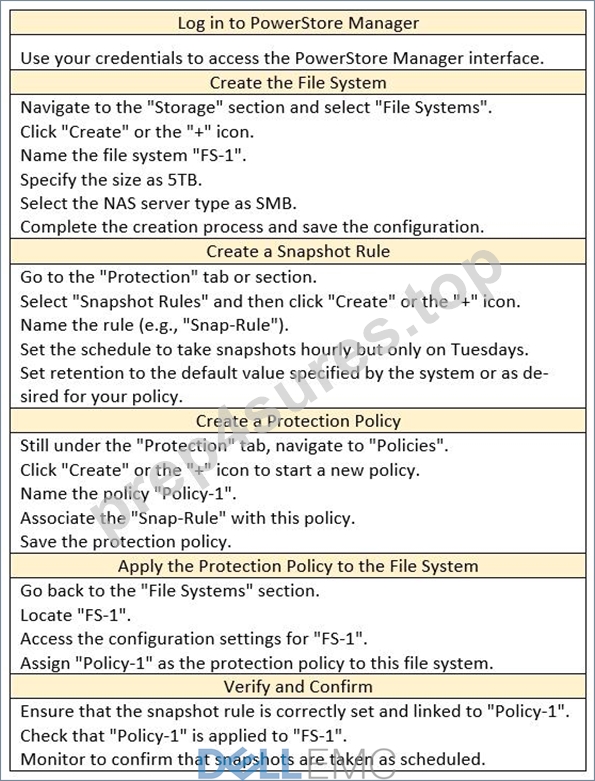
1. Create the File System
Navigate to Storage > File Systems.
Click Add File System.
Enter the file system name: FS-1
Set the file system size to 5 TB.
Select the appropriate NAS Server (SMB-NAS Server in this case).
Click Add.
2. Create the Protection Policy
Navigate to Protection > Protection Policies.
Click Add Protection Policy.
Enter the policy name: Policy-1
Click Next.
3. Configure the Snapshot Rule
In the "Snapshot Rules" section, click Add Rule.
Enter a name for the rule (e.g., "Snap-Rule").
Set the Days to Tuesday.
Set the Every field to 1 Hour.
Ensure that Retention is set to the default value.
Click Add.
Click Next.
4. Review and Finish
Review the protection policy summary.
Click Finish.
5. Apply the Protection Policy to the File System
Navigate back to Storage > File Systems.
Locate the FS-1 file system.
Click the More Actions button (three vertical dots) and select Edit.
In the "Protection Policy" field, select the newly created Policy-1 from the dropdown list.
Click Save.
Verification
To verify the configuration, go to Protection > Protection Policies.
Select Policy-1.
You should see the configured snapshot rule ("Snap-Rule") with the specified settings.
Key Considerations
Default Retention: The default retention for snapshots in PowerStore will vary depending on your system configuration. Ensure that the default retention meets your data protection needs.
Snapshot Schedule: The snapshot rule you created will take hourly snapshots of the file system every Tuesday.
By following these steps, you'll successfully create the protection policy with the specified snapshot rule and apply it to the new file system, meeting all the requirements of the simulation task.
NEW QUESTION # 106
What are some common sources from which PowerStore Migration can import data?
- A. Legacy storage arrays
- B. Video streaming services
- C. Social media platforms
- D. Third-party weather apps
Answer: A
NEW QUESTION # 107
What describes the process used in the Import External Storage migration architecture?
- A. Orchestrator on PowerStore communicates over the data path to the host plugin and controls the multipathing active path to storage
- B. Orchestrator on PowerStore communicates over the control path to the host plugin and controls the multipathing active path to storage
- C. Plugin on PowerStore communicates over the data path to orchestrator on the host and controls the multipathing active path to storage
- D. Plugin on PowerStore communicates over the control path to orchestrator on the host and controls the multipathing active path to storage
Answer: A
NEW QUESTION # 108
What is required to establish client access to PowerStore file storage using NFS or SMB protocols?
- A. IP addresses of clients
- B. World Wide Names (WWNs)
- C. Host initiator software
- D. SNMP community strings
Answer: A
NEW QUESTION # 109
When planning rack layout, why should base enclosures be grouped together?
- A. Ease of cable management
- B. Rack weight balance
- C. Power distribution requirements
- D. Hot aisle requirement
Answer: A
NEW QUESTION # 110
Which statement about File Mobility Network configuration is correct?
- A. File mobility network is created on the same subnet and VLAN as the management network
- B. File mobility network is created under the management tab in PowerStore Manager
- C. File mobility network is created with an optional Cluster IP
- D. File mobility network is created on the same subnet and VLAN. as the storage network
Answer: A
NEW QUESTION # 111
What is the purpose of configuring Ethernet switching for a PowerStore system?
- A. To enable Wi-Fi connectivity
- B. To optimize storage capacity
- C. To manage power distribution
- D. To establish network connectivity between storage nodes
Answer: D
NEW QUESTION # 112
......
D-PST-DY-23 Exam Dumps For Certification Exam Preparation: https://realdumps.prep4sures.top/D-PST-DY-23-real-sheets.html