


[Jun-2026] Latest Juniper JN0-105 Certification Practice Test Questions
Verified JN0-105 Dumps Q&As - 1 Year Free & Quickly Updates
NEW QUESTION # 16
Click the Exhibit button.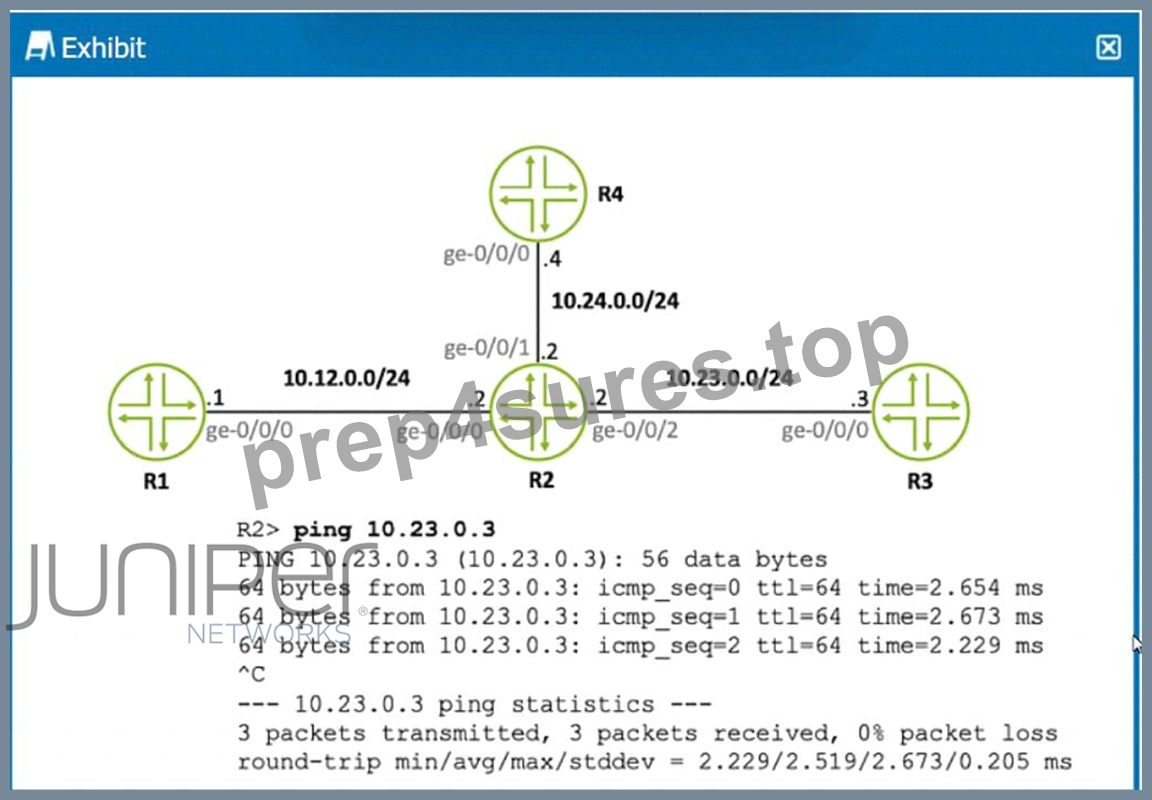
Referring to the exhibit, what is the source IP address of the ping that was executed?
- A. 10.24.0.4
- B. 10.23.0.2
- C. 10.12.0.2
- D. 10.23.0.3
Answer: B
Explanation:
The exhibit shows a ping test being executed from router R2 to the IP address 10.23.0.3. Since the ping command is issued on R2 and we see successful replies from 10.23.0.3, it means the source of the ping must be an interface on R2. Given the network diagram and the IP address scheme, the source IP address of the ping is on the interface ge-0/0/2 of R2, which is in the subnet 10.23.0.0/24. The only logical IP address for R2's interface in this subnet, based on standard networking practices and the given options, would be 10.23.0.2. The other addresses provided in the options belong to different subnets or are the destination of the ping itself.
NEW QUESTION # 17
You are logged in to a Junos OS device with SSH and issued the show protocols | compare command in the configuration, but no output is shown.
Which statement is correct in this scenario?
- A. You must commit the configuration before any output will be shown.
- B. Someone accidentally deleted the active configuration.
- C. The command only works for interface configuration differences.
- D. There are no changes to the candidate configuration.
Answer: D
Explanation:
The show | compare command in Junos OS is used to display the differences between the candidate configuration and the active configuration. If no output is shown when you issue this command, it means that there are no changes between the candidate configuration and the active configuration. This indicates that the candidate configuration is identical to the active configuration, and thus no differences are displayed.
NEW QUESTION # 18
Which two statements apply to the Routing Engine functions? (Choose two.)
- A. It processes the transit traffic.
- B. It responds to ping and traceroute commands.
- C. It does not process routing updates.
- D. It maintains the routing tables.
Answer: B,D
Explanation:
The Routing Engine (RE) in Juniper Networks devices plays a critical role in the control plane operations.
One of its functions includes responding to network utility commands like ping and traceroute, which are essential for diagnosing network connectivity and path issues. Furthermore, the RE is responsible for maintaining the routing tables, which contain information about network paths and destinations. These tables are vital for making forwarding decisions but are distinct from the actual forwarding of packets, which is handled by the Packet Forwarding Engine (PFE).
NEW QUESTION # 19
Click the Exhibit button.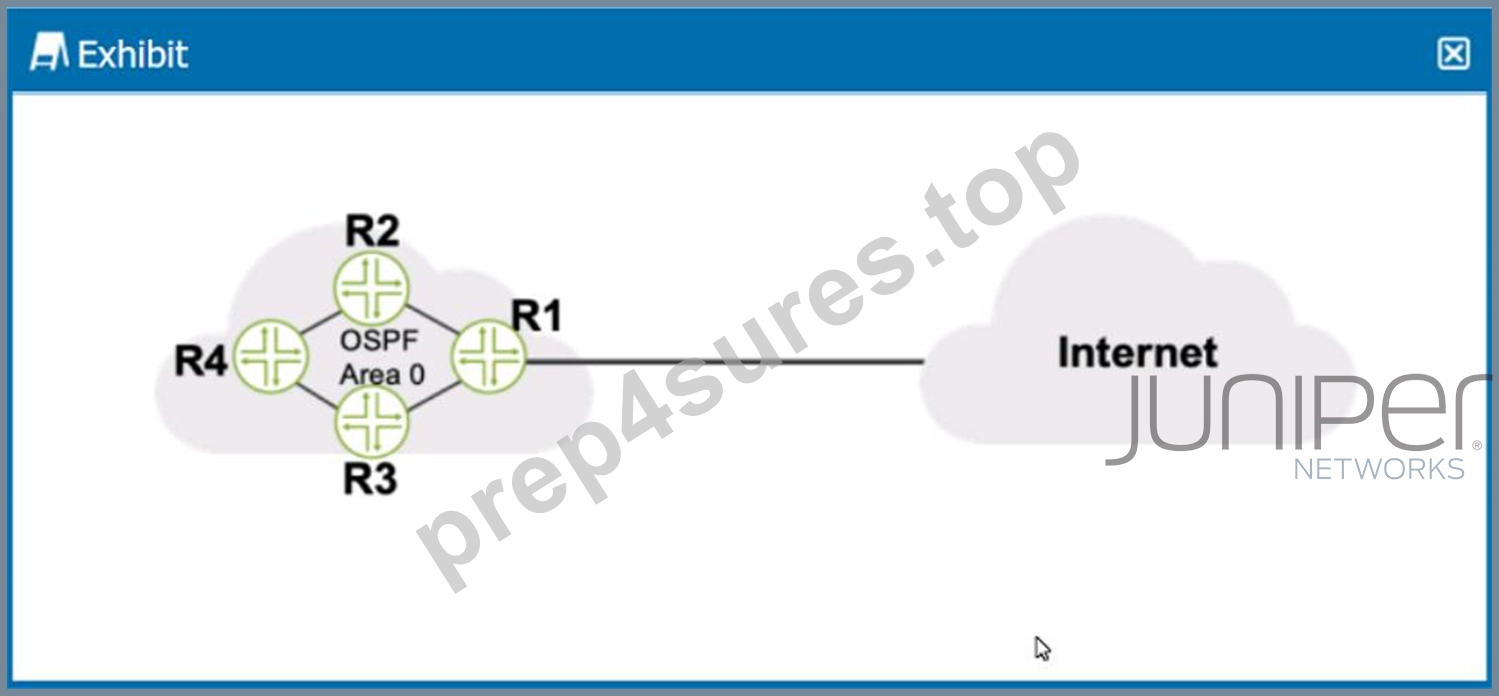
Referring to the exhibit, what should be configured on R1 to advertise a default static route into OSPF?
- A. a firewall filter
- B. a management interface
- C. a routing policy
- D. a loopback interface
Answer: C
Explanation:
To advertise a default static route into OSPF on router R1, a routing policy should be configured. This policy would typically include a statement to match the default route (0.0.0.0/0) and then apply an action to set the route as an OSPF external type, which would then be redistributed into the OSPF domain. The routing policy is a set of conditions and actions that determine how routes are imported into or exported from the routing table and how routes are shared between routing instances or routing protocols. After defining the policy, it must be applied to OSPF under the export section of the OSPF configuration on R1. This process will allow R1 to announce the default route to other OSPF routers in the network, which then can use it as a gateway of last resort to reach the Internet or other networks not explicitly known to the OSPF domain.
NEW QUESTION # 20
You are asked to configure your device running Junos OS to automatically archive your configuration upon commit In this scenario, which two methods are supported by the Junos OS? (Choose two)
- A. SCP
- B. RCP
- C. FTP
- D. HTTP
Answer: A,B
Explanation:
Junos OS supports multiple methods for automatically archiving configurations upon commit. Two of the supported methods are SCP (Secure Copy Protocol) and RCP (Remote Copy Protocol). These methods can be configured to save the configuration files to a remote server automatically whenever a commit is made.
NEW QUESTION # 21
Exhibit
{hold:node0}[edit]
root# set system root-authentication ?
Possible completions:
+ apply-groups Groups from which to inherit configuration data
+ apply-groups-except Don't inherit configuration data from these groups
encrypted-password Encrypted password string
load-key-file File (URL) containing one or more ssh keys
plain-text-password Prompt for plain text password (autoencrypted)
> ssh-dsa Secure shell (ssh) DSA public key string
> ssh-rsa Secure shell (ssh) RSA public key string
{hold:node0}[edit]
root# set system root-authentication plain-text-password
New password:
Retype new password:
{hold:node0}[edit]
root# commit and-quit
[edit interfaces]
'ge-0/0/0'
HA management port cannot be configured
error: configuration check-out failed
{hold:node0}[edit]
root#
You are unable to remotely access your Juniper device using the CLI.
Referring to the exhibit, which command would you add to the existing configuration to enable remote CLI access?
- A. set system services ssh
- B. set system login idle-timeout 20
- C. load factory-default
- D. set system root-authentication plain-text-password
Answer: A
Explanation:
In Junos OS, remote access to the device's CLI is commonly facilitated through Secure Shell (SSH), a protocol providing secure command-line access over an insecure network. The given exhibit indicates an attempt to set a root authentication password but does not show configuration for enabling remote access services. To enable SSH, which is not shown in the configuration snippet, you need to configure the device to accept SSH connections. This is done by enabling the SSH service within the system services hierarchy of the configuration. The correct command to add to the existing configuration for enabling remote CLI access via SSH is set system services ssh. This command activates the SSH service, allowing secure remote logins to the device.
NEW QUESTION # 22
Which type of device uses the destination IP address to forward packets?
- A. Layer 2 switch
- B. repeater
- C. Layer 3 router
- D. hub
Answer: C
Explanation:
A Layer 3 router forwards packets based on the destination IP address. It operates at the network layer of the OSI model and uses routing tables to determine the best path for packet delivery. Unlike Layer 2 switches, which forward packets based on MAC addresses, routers handle logical addressing, making them crucial for inter-network communication.
Reference:
Junos OS Documentation on Routing Fundamentals.
NEW QUESTION # 23
Your network infrastructure transports data, voice, and video traffic. Users are complaining that voice and video calls are not performing to their expectations.
In this scenario, which technology would you implement to improve voice and video performance on your network?
- A. CoS
- B. STP
- C. IPv6
- D. NAT
Answer: A
Explanation:
In a network that carries diverse types of traffic like data, voice, and video, ensuring the performance of latency-sensitive applications such as voice and video calls is crucial. Class of Service (CoS) is a technology designed to prioritize network traffic, ensuring that critical applications like voice and video receive the necessary bandwidth and minimal latency. CoS mechanisms can include traffic classification, traffic policing, queue management, and scheduling. By implementing CoS, network administrators can assign higher priority to voice and video traffic, thus improving their performance across the network and addressing the users' complaints about call quality.
NEW QUESTION # 24
Which protocol is responsible for learning an IPv4 neighbor's MAC address?
- A. Network Address Translation (NAT)
- B. Neighbor Discovery Protocol (NDP)
- C. Media Access Control Security (MACsec)
- D. Address Resolution Protocol (ARP)
Answer: D
Explanation:
The Address Resolution Protocol (ARP) is a fundamental protocol used in IPv4 networking to map an IP address to its corresponding MAC (Media Access Control) address. When an IPv4 device wants to communicate with another device on the same local network, it uses ARP to find out the MAC address associated with the target device's IP address. This ensures that IP packets can be encapsulated into Ethernet frames and delivered to the correct hardware address on the local network segment. ARP does not apply to IPv6, where Neighbor Discovery Protocol (NDP) performs a similar function.
NEW QUESTION # 25
Which two components are included in a transport header? (Choose two.)
- A. destination port number
- B. destination MAC address
- C. source port number
- D. source MAC address
Answer: A,C
Explanation:
The transport layer in the OSI model is responsible for end-to-end communication and error recovery. In a transport header, such as TCP or UDP, the key components include the source port number and the destination port number. These port numbers are used to identify sending and receiving applications. The source port number indicates the port of the sending application, and the destination port number refers to the port of the receiving application. MAC addresses, on the other hand, are part of the data link layer (Layer 2) and would be included in an Ethernet header, not a transport header.
NEW QUESTION # 26
Which two statements are correct about the empioyee@Ri> prompt? (Choose two.)
- A. R1 is the hostname of your device.
- B. You are at a shell prompt.
- C. You are in configuration mode.
- D. You are in operational mode.
Answer: A,D
Explanation:
In Junos OS, the prompt employee@R1> indicates the current context of the user interface. The 'R1' part of the prompt signifies the hostname of the device, which in this case is 'R1'. The absence of a '#' symbol at the end of the prompt suggests that the user is in operational mode, as opposed to configuration mode which is indicated by a prompt ending in '#'. Operational mode allows users to view the status of the device and execute operational commands, but does not allow for configuration changes.
NEW QUESTION # 27
Which statement is correct when multiple users are configuring a Junos device using the configure private command?
- A. A commit by any user will commit changes made by all active users.
- B. Each user shares the same candidate configuration.
- C. Each user gets their own candidate configuration.
- D. A commit will not succeed until there is only a single user in configuration mode.
Answer: C
Explanation:
When multiple users are configuring a Junos device using the "configure private" command, each user gets their own candidate configuration (C). This allows for isolated configuration sessions, where changes made by one user do not impact or interfere with the changes made by another user in their private session.
NEW QUESTION # 28
You issue the telnet 10.10.10.1 source 192.168.100.1 command.
Which two statements are correct in this scenario? (Choose two.)
- A. The telnet session will have a destination address of 192.168.100.1.
- B. The telnet session will have a destination address of 10.10.10.1.
- C. The telnet session will have a source address of 10.10.10.1.
- D. The telnet session will have a source address of 192.168.100.1.
Answer: B,D
Explanation:
In the given telnet command, "telnet 10.10.10.1 source 192.168.100.1," the destination address of the telnet session is 10.10.10.1, and the source address of the session is specified as 192.168.100.1, making C and D the correct answers. This command instructs the telnet client to use the specified source IP address when establishing the connection to the destination.
NEW QUESTION # 29
What are two functions of the routing protocol daemon (rpd)? (Choose two.)
- A. It creates forwarding tables.
- B. It maintains routing tables.
- C. It provides access to the CLI.
- D. It generates chassis alarms.
Answer: A,B
Explanation:
The Routing Protocol Daemon (rpd) is a critical component in Juniper Networks devices, responsible for all routing operations. It maintains routing tables, which hold information about network paths and destinations derived from various routing protocols. These tables are used to make decisions about where to send packets. Additionally, rpd generates forwarding tables based on the information in the routing tables. The forwarding tables are then used by the Packet Forwarding Engine (PFE) to actually forward packets to their next hop or final destination.
NEW QUESTION # 30
Which three benefits occur when operating an interior gateway protocol (IGP) in an autonomous system (AS)?
(Choose three.)
- A. IGPs learn prefixes in the global Internet's routing table.
- B. IGPs automatically distribute static routing information.
- C. IGPs determine the optimal paths for data transmission.
- D. IGPs react very fast to network change.
- E. IGPs learn everything about the subnets and best paths within your network.
Answer: C,D,E
Explanation:
Operating an Interior Gateway Protocol (IGP) within an Autonomous System (AS) provides several benefits, including determining the optimal paths for data transmission (B), reacting quickly to network changes (D), and learning all about the subnets and best paths within the network (E). IGPs are designed to manage routing within a single AS efficiently, adapting to changes and ensuring data is routed through the best available paths.
NEW QUESTION # 31
Exhibit.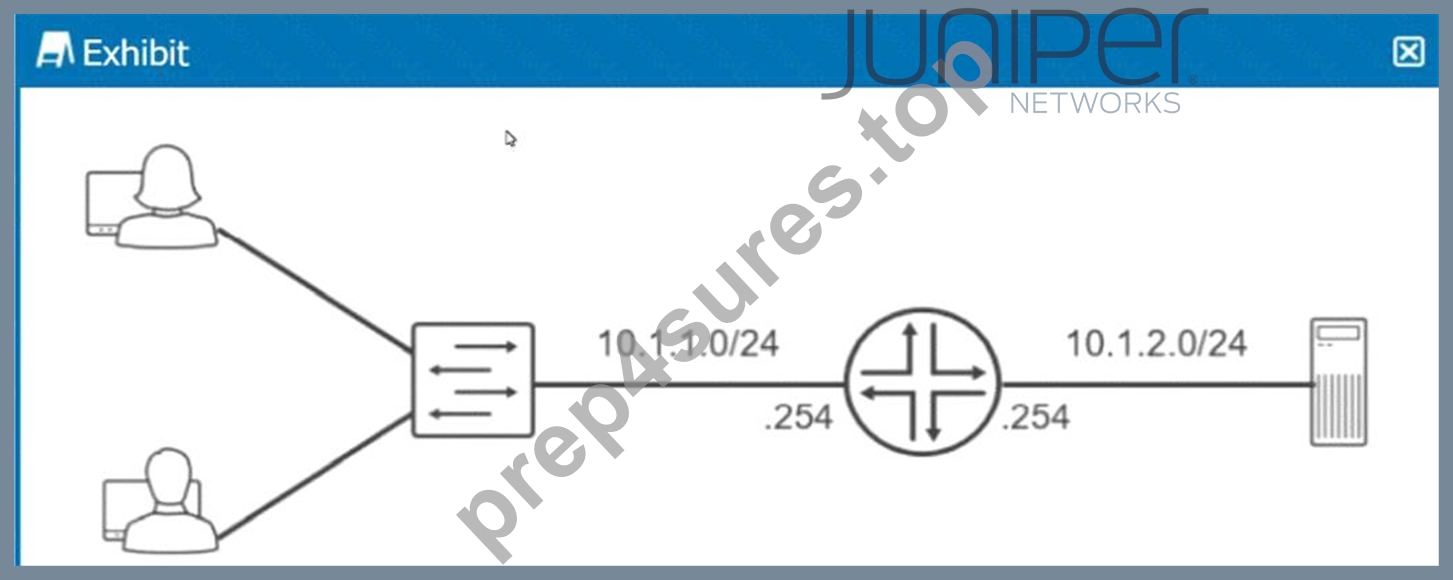
Referring to the exhibit, which routing configuration is required for these two users to access the remote server?
- A. A routing protocol must be enabled on the router.
- B. Users and the server require a default gateway.
- C. Trunk ports must be enabled on the switch.
- D. Users must connect directly to the router.
Answer: B
Explanation:
In a typical network configuration, users and servers require a default gateway to communicate with devices on different networks or subnets. The default gateway is usually the router's interface on the same network, which routes the traffic to other networks. This is essential for the two users to access the remote server if the server is on a different subnet, which is indicated by the different network addresses.
NEW QUESTION # 32
You are asked to view the real-time usage statistics for the busiest interfaces on a device running Junos OS.
Which command will achieve this task?
- A. show interfaces extensive
- B. monitor interface traffic
- C. monitor traffic
- D. monitor traffic absolute-sequence
Answer: B
Explanation:
To view real-time usage statistics for the busiest interfaces on a device running Junos OS, the correct command is B, "monitor interface traffic." This command provides a dynamic, real-time view of the traffic flowing through the interfaces, allowing administrators to quickly identify and monitor the busiest interfaces on the device.
NEW QUESTION # 33
How many login classes are assignable to a user account?
- A. 0
- B. 1
- C. 2
- D. 3
Answer: C
Explanation:
Junos OS supports multiple login classes that can be assigned to user accounts, allowing for different levels of access and permissions. The correct answer is C, 4. These classes include "super-user," "read-only,"
"operator," and "unauthorized." Each class provides a different level of access to the Junos device, ranging from full configuration and operational command privileges to limited access for monitoring and viewing configurations.
NEW QUESTION # 34
You want to configure the management port on a Juniper device. In this scenario, what is the management interface name?
- A. mt0
- B. mtun0
- C. fxp0
- D. st0
Answer: C
Explanation:
In Junos OS, the dedicated out-of-band management interface is typically named fxp0. This interface is used exclusively for management traffic and is physically separated from the data traffic interfaces. It allows administrators to perform management tasks even when the device is experiencing issues that affect the forwarding plane.
From the JNCIA-Junos Study Guide and Junos OS Documentation:
"The fxp0 interface is a dedicated management interface that provides out-of-band management access. It is commonly found on Juniper routers, switches, and security platforms. You assign IP addresses to this interface as you would any other, and it is often used to connect to a management network or to allow SSH, Telnet, or SNMP access."
- Junos OS Fundamentals, Chapter: Interfaces
- Junos OS Documentation: Management Interfaces Overview
- JNCIA-Junos Exam Objective: Interface Types
Reference:
Junos OS Fundamentals Guide
JNCIA-Junos Exam Objectives (JN0-105)
Junos Interface Naming Conventions, Juniper TechLibrary
NEW QUESTION # 35
Which prompt indicates that you are using configuration mode?
- A. >
- B. #
- C. $
- D. %
Answer: B
Explanation:
In Junos OS, the # prompt indicates that you are in configuration mode. This mode is used for making changes to the configuration of the device.
Reference: Juniper Networks CLI Modes
"The # prompt indicates that you are in configuration mode."
NEW QUESTION # 36
Which two statements are correct about Junos traceoptions? (Choose two.)
- A. Traceoptions are enabled through configuration.
- B. Traceoptions are enabled by default.
- C. Traceoption output, by default, is stored in /var/iog/<fiie-name>.
- D. Traceoptions cannot be enabled in a production environment.
Answer: A,C
NEW QUESTION # 37
You received a new Junos device and are configuring the system-related settings. You must configure this device for the current date and time on the US West coast. You have set the time zone to America/Los_Angeies. however the time and date did not change.
In this scenario, which two additional actions would satisfy this requirement? (Choose two.)
- A. Configure a DNS server.
- B. Configure an NTP server.
- C. Set the date and time setting manually.
- D. Reboot the device.
Answer: B,C
Explanation:
When configuring the system-related settings for the current date and time on a Junos device, especially for a specific time zone like America/Los_Angeles, and the time does not automatically adjust, two effective actions can be taken. Firstly, setting the date and time manually allows for immediate correction of the system clock. This can be done via the CLI with the appropriate set date and time command. Secondly, configuring the device to use an NTP server can provide ongoing synchronization with an accurate time source, ensuring that the device maintains the correct time and date automatically in the future, even in the case of restarts or minor drifts in the internal clock.
NEW QUESTION # 38
You have configured some interfaces on a Junos device; however, you have not yet committed the configuration.
What happens if you issue the rollback 0 command in this scenario?
- A. The Junos device is rebooted.
- B. The interface changes you made are discarded.
- C. The messages.log file is deleted.
- D. The factory default configuration is loaded.
Answer: B
Explanation:
Issuing the rollback 0 command in Junos OS will discard any uncommitted changes and revert to the last committed configuration. This command effectively cancels any configuration changes that have been made but not yet committed, ensuring that the device returns to its previous stable state.
References:
"rollback 0 ...................................(rolls back the changes just made )" from Useful Juniper Commands.txt.
Juniper official documentation: Rolling Back a Configuration.
NEW QUESTION # 39
Which protocol is responsible for learning an IPv4 neighbor's MAC address?
- A. Network Address Translation (NAT)
- B. Neighbor Discovery Protocol (NDP)
- C. Media Access Control Security (MACsec)
- D. Address Resolution Protocol (ARP)
Answer: D
Explanation:
The Address Resolution Protocol (ARP) is responsible for mapping an IPv4 address to a machine's MAC address. ARP operates at Layer 2 of the OSI model and is used to find the MAC address of a host given its IPv4 address. When a device wants to communicate with another device on the same local network, it uses ARP to discover the recipient's MAC address.
References:
* Juniper official documentation: ARP.
* Networking standards: RFC 826.
NEW QUESTION # 40
......
Latest 2026 Realistic Verified JN0-105 Dumps - 100% Free JN0-105 Exam Dumps: https://realdumps.prep4sures.top/JN0-105-real-sheets.html