


[Mar-2026] The Open Group OGEA-101 Dumps – Reduce Your Chance of Failure in OGEA-101 Exam
To help you achieve your ultimate goal, we suggest the actual The Open Group OGEA-101 dumps for your TOGAF Enterprise Architecture Part 1 Exam exam preparation to use as your guideline.
NEW QUESTION # 89
Exhibit
Consider the illustration showing an architecture development cycle Which description matches the phase of the ADM labeled as item 1?
- A. Conducts implementation planning for the architecture defined in previous phases
- B. Establishes procedures for managing change to the new architecture
- C. Operates the process of managing architecture requirements
- D. Provides architectural oversight for the implementation
Answer: C
Explanation:
The illustration shows an architecture development cycle based on the TOGAF ADM (Architecture Development Method), which is a method for developing and managing an enterprise architecture1.
The ADM consists of nine phases, each with a specific purpose and output. The phases are1:
Preliminary Phase: To prepare and initiate the architecture development cycle, including defining the architecture framework, principles, and governance.
Phase A: Architecture Vision: To define the scope, vision, and stakeholders of the architecture initiative, and to obtain approval to proceed.
Phase B: Business Architecture: To describe the baseline and target business architecture, and to identify the gaps between them.
Phase C: Information Systems Architectures: To describe the baseline and target data and application architectures, and to identify the gaps between them.
Phase D: Technology Architecture: To describe the baseline and target technology architecture, and to identify the gaps between them.
Phase E: Opportunities and Solutions: To identify and evaluate the opportunities and solutions for implementing the target architecture, and to define the work packages and transition architectures.
Phase F: Migration Planning: To finalize the implementation and migration plan, and to ensure alignment with the enterprise portfolio and project management.
Phase G: Implementation Governance: To provide architecture oversight and guidance for the implementation projects, and to manage any architecture change requests.
Phase H: Architecture Change Management: To monitor the changes in the business and technology environment, and to assess the impact and performance of the architecture.
In addition to these phases, there is a central process called Requirements Management, which is labeled as item 1 in the illustration. This process operates throughout the ADM cycle, and its purpose is to manage the architecture requirements throughout the architecture development, ensuring that they are aligned with the business requirements and the stakeholder concerns2.
Therefore, the description that matches the phase of the ADM labeled as item 1 is C. Operates the process of managing architecture requirements.
1: The TOGAF Standard, Version 9.2, Chapter 5: Architecture Development Method (ADM)
2: The TOGAF Standard, Version 9.2, Chapter 17: Requirements Management
NEW QUESTION # 90
Consider the following statements:
1. Each contracted party is required to act responsibly to the organization and its stakeholders.
2. All decisions taken, processes used, and their implementation will not be allowed to create unfair advantage to any one particular party.
3. Digital Transformation and operations will be more effective and efficient.
4. Strategic decision-making by C-Level executives and business leaders will be more effective.
Which statements highlight the value and necessity for Architecture Governance to be adopted within organizations?
- A. 1 & 4
- B. 2 & 3
- C. 3 & 4
- D. 1 & 2
Answer: D
Explanation:
Architecture governance is the practice of ensuring compliance with the enterprise architecture and its principles, standards, and goals. Architecture governance provides the means to establish, monitor, and control the architecture development and implementation processes, and to resolve any issues or conflicts that may arise. Architecture governance also ensures that all stakeholders are represented and involved in the decision-making process, and that their interests and concerns are balanced and aligned. Statements 1 and 2 highlight the value and necessity for architecture governance to be adopted within organizations, as they emphasize the importance of responsibility, accountability, fairness, and transparency in the architectural activities. Statements 3 and 4 are more related to the benefits and outcomes of having a good enterprise architecture, rather than the governance aspect.
Reference: : The TOGAF Standard, Version 9.2, Part VI: Architecture Capability Framework, Chapter 50: Architecture Governance : The TOGAF Standard, Version 9.2, Part III: ADM Guidelines and Techniques, Chapter 29: Architecture Governance
NEW QUESTION # 91
Which of the following best describes a purpose of the Gap Analysis technique?
- A. To validate non-functional requirements
- B. To establish quality metrics for the architecture
- C. To determine service levels for the architecture
- D. To identify missing functions
Answer: D
Explanation:
Gap analysis is a technique that is used to validate an architecture by highlighting the shortfall between the Baseline Architecture and the Target Architecture. One of the purposes of gap analysis is to identify missing functions that are either deliberately omitted, accidentally left out, or not yet defined in the Target Architecture. Missing functions are marked as gaps that need to be filled by developing or procuring the building blocks.
NEW QUESTION # 92
Refer to the table below: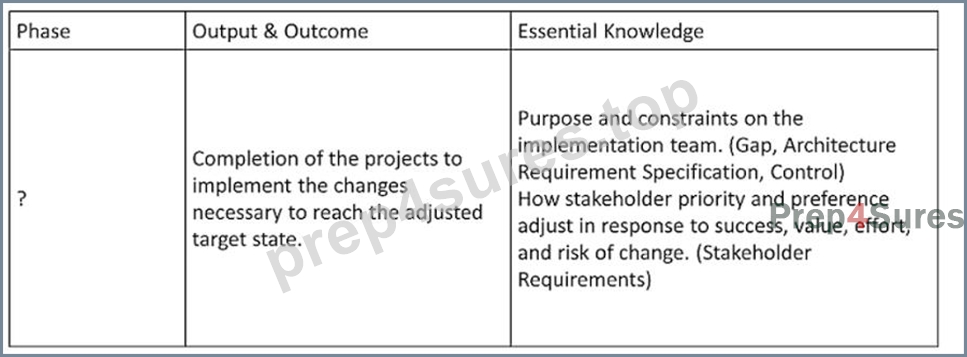
Which ADM Phase does this describe?
- A. Phase G
- B. Phase F
- C. Phase A
- D. Phase E
Answer: A
Explanation:
The table describes the output, outcome, and essential knowledge of an ADM phase that oversees the implementation of changes necessary to reach the adjusted target state. This corresponds to Phase G, also known as Implementation Governance, which ensures that the architecture defined in earlier phases is realized, and it oversees the development and implementation of projects to align with this architecture. The essential knowledge required during this phase includes understanding constraints on the implementation team and adjusting stakeholder priority and preference in response to success, value, effort, and risk of change. Reference: TOGAF Version 9.1 - 1
NEW QUESTION # 93
Complete the sentence. When considering agile development, Architecture to Support Project will identify what products the Enterprise needs, the boundary of the products, and what constraints a product owner has; this defines the Enterprise's ____________
- A. workflow management
- B. operations
- C. lifecycle economics
- D. backlog
Answer: A
NEW QUESTION # 94
Which of the following best describes purpose of the Business Scenarios?
- A. To catch errors in a project architecture early
- B. To identify and understand requirements
- C. To guide decision making throughout the enterprise
- D. To identify risk when implementing an architecture project
Answer: B
Explanation:
Business scenarios are a technique for capturing, clarifying, and communicating the functional and non- functional requirements of a system. Business scenarios describe the business environment, the actors involved, the desired outcomes, and the processes or rules that govern the behavior of the system. Business scenarios are useful for ensuring that the architecture addresses the real needs and concerns of the stakeholders, and for validating and testing the architecture against expected situations. Business scenarios are developed in Phase A: Architecture Vision of the ADM cycle, and refined and updated throughout the other phases3 References: 3: The TOGAF Standard, Version 9.2, Part III: ADM Guidelines and Techniques, Chapter 26: Business Scenarios : The TOGAF Standard, Version 9.2, Part II: Architecture Development Method (ADM), Chapter 18: Phase A: Architecture Vision
NEW QUESTION # 95
What does the TOGAF ADM recommend for use in developing an Architecture Vision document?
- A. Architecture Principles
- B. Business Scenarios
- C. Gap Analysis
- D. Requirements Management
Answer: B
Explanation:
Business scenarios are a technique recommended by the TOGAF ADM for use in developing an Architecture Vision document12. Business scenarios are a means of capturing the business requirements and drivers, the processes and actors involved, and the desired outcomes and measures of success34. Business scenarios help to create a common vision and understanding among the stakeholders, and to identify and validate the architecture requirements . Business scenarios also provide a basis for analyzing the impact and value of the proposed architecture. References:
*The TOGAF Standard, Version 9.2 - Phase A: Architecture Vision - The Open Group
*TOGAF Standard - Introduction - Phase A: Architecture Vision
*The TOGAF Standard, Version 9.2 - Definitions - The Open Group
*Business Scenarios - The Open Group
*[The TOGAF Standard, Version 9.2 - Architecture Requirements Specification - The Open Group]
*[The TOGAF Standard, Version 9.2 - Architecture Vision - The Open Group]
*[The TOGAF Standard, Version 9.2 - Business Transformation Readiness Assessment - The Open Group]
NEW QUESTION # 96
Which of the following is the application of the concepts of risk assessment and risk analysis in the decision- making process?
- A. Information Security Management
- B. Risk Management
- C. Security Architecture
- D. Security Governance
Answer: B
NEW QUESTION # 97
Consider the following ADM phases objectives.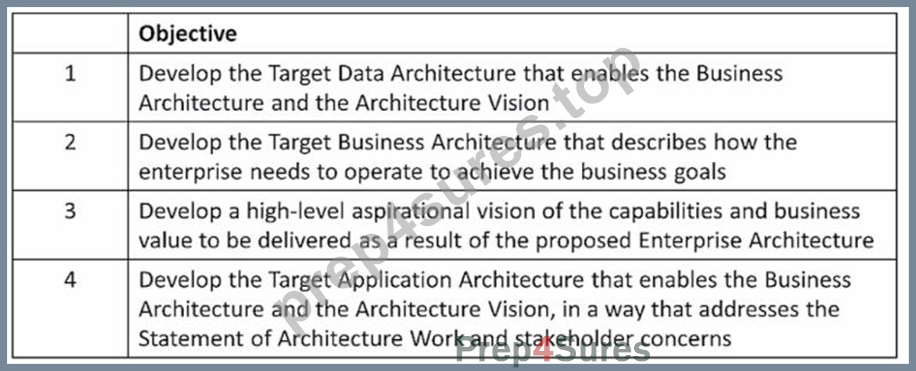
Which phase does each objective match?
- A. 1C-2B-3A-4C
- B. 1B-2D-3A-4C
- C. 1A-2B-3C-4D
- D. 1C-2D-3B-4A
Answer: A
Explanation:
* The objectives listed in the question correspond to the objectives of different phases of the TOGAF ADM (Architecture Development Method), which is a method for developing and managing an enterprise architecture1.
* The ADM consists of nine phases, each with a specific purpose and output. The phases are1:
oPreliminary Phase: To prepare and initiate the architecture development cycle, including defining the architecture framework, principles, and governance.
oPhase A: Architecture Vision: To define the scope, vision, and stakeholders of the architecture initiative, and to obtain approval to proceed.
oPhase B: Business Architecture: To describe the baseline and target business architecture, and to identify the gaps between them.
oPhase C: Information Systems Architectures: To describe the baseline and target data and application architectures, and to identify the gaps between them.
oPhase D: Technology Architecture: To describe the baseline and target technology architecture, and to identify the gaps between them.
oPhase E: Opportunities and Solutions: To identify and evaluate the opportunities and solutions for implementing the target architecture, and to define the work packages and transition architectures.
oPhase F: Migration Planning: To finalize the implementation and migration plan, and to ensure alignment with the enterprise portfolio and project management.
oPhase G: Implementation Governance: To provide architecture oversight and guidance for the implementation projects, and to manage any architecture change requests.
oPhase H: Architecture Change Management: To monitor the changes in the business and technology environment, and to assess the impact and performance of the architecture.
* Based on the above definitions, we can match each objective with the corresponding phase as follows:
oObjective 1: Develop the Target Data Architecture that enables the Business Architecture and the Architecture Vision. This objective is achieved in Phase C: Information Systems Architectures, where the data architecture is defined as a subset of the information systems architecture2.
oObjective 2: Develop the Target Business Architecture that describes how the enterprise needs to operate to achieve the business goals. This objective is achieved in Phase B: Business Architecture, where the business architecture is defined as a subset of the enterprise architecture3.
oObjective 3: Develop a high-level aspirational vision of the capabilities and business value to be delivered as a result of the proposed Enterprise Architecture. This objective is achieved in Phase A: Architecture Vision, where the architecture vision is defined as a high-level description of the target architecture and its benefits4.
oObjective 4: Develop the Target Application Architecture that enables the Business Architecture and the Architecture Vision, in a way that addresses the Statement of Architecture Work and stakeholder concerns. This objective is achieved in Phase C: Information Systems Architectures, where the application architecture is defined as a subset of the information systems architecture2.
Reference:
* 1: The TOGAF Standard, Version 9.2, Chapter 5: Architecture Development Method (ADM)
* 2: The TOGAF Standard, Version 9.2, Chapter 9: Phase C: Information Systems Architectures
* 3: The TOGAF Standard, Version 9.2, Chapter 8: Phase B: Business Architecture
* 4: The TOGAF Standard, Version 9.2, Chapter 7: Phase A: Architecture Vision
NEW QUESTION # 98
Refer to the exhibit.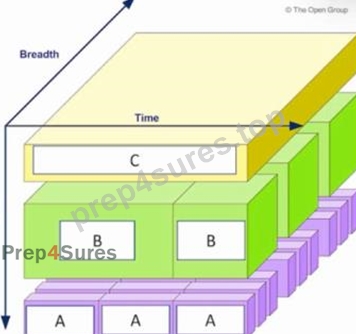
Consider the diagram showing a classification model for Architecture Landscapes.
What are the items labelled A, B and C?
- A. A-Corporate Capability, B-Portfolio Capability, C-Project Capability
- B. A-Capability Architecture, B-Segment Architecture, C-Enterprise Strategic Architecture
- C. A-Strategy Architecture, B-Tactic Architecture, C-Operational Architecture
- D. A-Architecture Vision, B-Business Architecture, C-Architecture Development
Answer: B
NEW QUESTION # 99
Consider the following statements describing the TOGAF ADM:
* All ADM activities are carried out within an iterative cycle of continuous architecture definition and realization
* The Requirements Management phase is a continuous phase
* Output from an early phase may be modified in a later phase
* When a phase starts, the previous phase closes
Which statements are correct?
- A. 1, 2 & 3
- B. 2, 3 & 4
- C. 1, 2 & 4
- D. 1, 3 & 4
Answer: A
Explanation:
Comprehensive and Detailed Explanation
Let's examine each statement against the TOGAF ADM principles:
* All ADM activities are carried out within an iterative cycle of continuous architecture definition and realization
* Correct. The ADM is iterative in three dimensions: across the cycle, between levels (enterprise, segment, capability), and within phases. This means architecture development is never linear but part of a continuous cycle of definition and realization.
* The Requirements Management phase is a continuous phase
* Correct. Requirements Management is central to the ADM cycle. It operates continuously, ensuring requirements are identified, stored, and addressed throughout all phases, not only in a single step.
* Output from an early phase may be modified in a later phase
* Correct. The ADM is iterative and allows feedback between phases. For example, new requirements identified in later phases may lead to modifications of deliverables from earlier phases.
* When a phase starts, the previous phase closes
* Incorrect. The ADM is not strictly sequential. Phases can overlap, iterate, and provide feedback loops.
One phase starting does not imply that the previous phase is closed; instead, phases interact dynamically.
Correct Mapping
* Statements 1, 2, and 3 are correct.
* Statement 4 is incorrect.
Correct answer is B (1, 2 & 3).
Why the other options are incorrect
* A (2, 3 & 4): Includes statement 4, which is incorrect.
* C (1, 2 & 4): Includes statement 4, which is incorrect.
* D (1, 3 & 4): Includes statement 4, which is incorrect.
References
* The Open Group, TOGAF Standard, Version 9.2, Part II: ADM - overview of ADM iterations, Requirements Management, and feedback between phases.
* The Open Group, TOGAF 9 Certified Study Guide - emphasizes ADM as iterative and requirements- driven.
NEW QUESTION # 100
Complete the sentence The Architecture Landscape is divided into levels known as__________________________.
- A. Segment Strategic and Capability Architectures
- B. Transitional Complete and incremental Architectures
- C. Gaps Plateaus, and Target Architectures
- D. Baseline. Transition and To Be Architectures
Answer: A
Explanation:
The Architecture Landscape is divided into levels known as Segment Strategic and Capability Architectures.
These levels correspond to different scopes and purposes of architectures within an enterprise. Segment Architectures are architectures that address specific business units, functions, or processes within an enterprise. Strategic Architectures are architectures that provide a high-level view of the enterprise's vision, goals, and direction. Capability Architectures are architectures that address specific business capabilities or services that span multiple segments or domains. Reference: The TOGAF Standard | The Open Group Website, Section 2.4 Architecture Repository.
NEW QUESTION # 101
Which statement about Requirements Management is most correct?
- A. Requirements Management is a step of all ADM Phases
- B. Stakeholder requirements are captured once in Phase A and managed throughout the ADM cycle
- C. The purpose of Requirements Management is to process change requests
- D. Requirements Management and stakeholder engagement are placed at the center of architecture development
Answer: D
Explanation:
This statement about Requirements Management is most correct because it reflects the central role of Requirements Management and stakeholder engagement in the ADM cycle. Requirements Management is not a step of all ADM Phases, but rather an ongoing process that ensures that all relevant requirements are elicited, analyzed, prioritized, and addressed throughout the architecture development and transition.
Stakeholder engagement is also a continuous activity that involves identifying, communicating, and managing stakeholder expectations and concerns. Reference: The TOGAF Standard | The Open Group Website, Section 3.1 Introduction to the ADM.
NEW QUESTION # 102
Consider the following chart: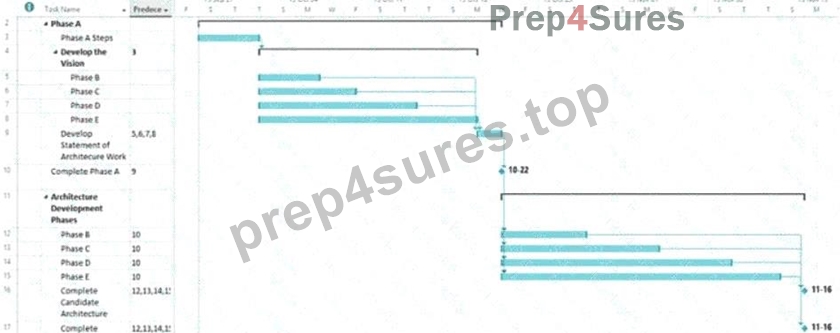
Question:
Which concept for Enterprise Architecture Practitioners does it illustrate?
- A. An Enterprise Architecture must be developed in phases with fixed durations as shown.
- B. Enterprise Architects must use Gantt charts to communicate the planning with stakeholders.
- C. ADM phases must be run simultaneously until the candidate architecture is tested for acceptance.
- D. ADM phases must be run sequentially to produce a candidate architecture.
Answer: C
Explanation:
The chart illustrates an important TOGAF concept: ADM phases can operate concurrently or iteratively rather than strictly sequentially. The diagram shows Phase A activities occurring first, after which the architecture development phases (Business, Data, Application, and Technology Architectures) overlap in time. This overlap demonstrates how architecture development work may proceed in parallel as information becomes available, allowing architects to refine and coordinate the candidate architecture more efficiently.
TOGAF explicitly supports iteration and concurrency across ADM phases. While the phases are presented in a logical order, they are not intended to be executed in a rigid step-by-step sequence in all situations. Instead, architects may work across several phases simultaneously to address dependencies, refine requirements, and accelerate the development of the candidate architecture and roadmap.
Option A best reflects this principle because it acknowledges that phases may run together as part of an iterative architecture development process until a coherent candidate architecture is produced and validated.
Option B is incorrect because TOGAF does not mandate the use of specific project management tools such as Gantt charts. Option C is incorrect because the ADM is not strictly sequential. Option D is incorrect because the duration of phases is not fixed in TOGAF.
Therefore, the chart illustrates the concept that ADM phases may be executed concurrently to develop and validate the candidate architecture.
NEW QUESTION # 103
Complete the following sentence. In the ADM, documents which are under development and have not undergone any formal review and approval process are called______ Documents which have been reviewed and approved are called ______
- A. "concept" - "deliverable"
- B. "Version 0.1" - "Version 1.0"
- C. "draft"- "finalized"
- D. "draft" - "approved"
Answer: D
Explanation:
According to the TOGAF Standard, 10th Edition, documents which are under development and have not undergone any formal review and approval process are called draft documents, while documents which have been reviewed and approved are called approved documents 1. Draft documents are typically marked with a version number of 0.x, indicating that they are incomplete or provisional. Approved documents are typically marked with a version number of 1.0 or higher, indicating that they have been finalized and authorized. The other options are not correct, as they are not the terms used by the TOGAF Standard to distinguish between documents under development and documents that have been reviewed and approved. The terms "finalized", "concept", "deliverable", and "Version 0.1" and "Version 1.0" are not specific to the TOGAF Standard, and they may have different meanings or interpretations in different contexts. Reference: 1: TOGAF Standard, 10th Edition, Part II: Architecture Development Method, Chapter 7: Applying Iteration to the ADM, Section 7.2.3 Document Categorization.
NEW QUESTION # 104
Which ADM Phase provides architectural oversight of the implementation?
- A. Phase G
- B. Phase H
- C. Preliminary
- D. Phase A
Answer: A
Explanation:
* Phase G: Implementation Governance provides architectural oversight of the implementation. It ensures that the implementation conforms to the Target Architecture using Architecture Contracts and governance frameworks.
* Phase H: Architecture Change Management is about maintaining the architecture lifecycle and handling new requirements, not direct implementation oversight.
* Preliminary Phase is about setting up the architecture capability.
* Phase A is about developing the Architecture Vision.
Reference: TOGAF Standard, Version 9.2, Part II: ADM, Phase G.
NEW QUESTION # 105 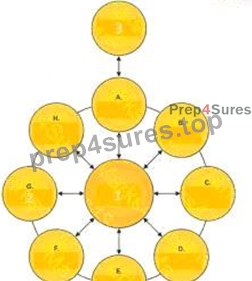
Consider the illustration of an architecture development cycle.
Select the correct phase names corresponding to the labels 1, 2 and 3?
- A. 1 Continuous Improvement - 2 Migration Planning - 3 Architecture Vision
- B. 1 Requirements Management - 2 Implementation Governance - 3 Preliminary
- C. 1 Requirements Management - 2 Change Management - 3 Strategy
- D. 1 Architecture Governance - 2 Implementation Governance - 3 Preliminary
Answer: C
NEW QUESTION # 106
Which of the following statements about architecture partitioning is correct?
- A. Partitions are defined and assigned to agile Enterprise Architecture teams.
- B. Partitions are used to simplify the management of the Enterprise Architecture.
- C. Partitions reflect the organization's structure.
- D. Partitions are equivalent to architecture levels.
Answer: B
Explanation:
Based on the web search results, architecture partitioning is a technique that divides the Enterprise Architecture into smaller and manageable segments or groups, based on various classification criteria, such as subject matter, time, maturity, volatility, etc.12 Architecture partitioning is used to simplify the development and management of the Enterprise Architecture, by reducing complexity, improving governance, enhancing reusability, and increasing alignment and agility12. Therefore, the statement that partitions are used to simplify the management of the Enterprise Architecture is correct.
The other statements are incorrect because:
*Partitions are not equivalent to architecture levels. Architecture levels are different layers of abstraction that describe the Enterprise Architecture from different perspectives, such as strategic, segment, and capability3.
Partitions are subsets of architectures that are defined within or across the levels, based on specific criteria1.
*Partitions do not necessarily reflect the organization's structure. The organization's structure is one possible criterion for partitioning the architecture, but it is not the only one. Other criteria, such as business function, product, service, geography, etc., can also be used to partition the architecture12.
*Partitions are not defined and assigned to agile Enterprise Architecture teams. Agile Enterprise Architecture is an approach that applies agile principles and practices to the architecture work, such as iterative development, frequent feedback, adaptive planning, and continuous delivery4. Partitions are not a specific feature of agile Enterprise Architecture, but a general technique that can be applied to any architecture method or framework, including TOGAF12.
NEW QUESTION # 107
Which of the following is the ability to develop use and sustain the architecture of a particular enterprise using architecture to govern change?
- A. An EA repository
- B. An EA Capability
- C. An Enterprise Architecture
- D. An EA framework
Answer: B
Explanation:
The ability to develop, use, and sustain the architecture of a particular enterprise using architecture to govern change is an EA Capability. An EA Capability is a set of skills, processes, roles, responsibilities, tools, and techniques that enable an enterprise to successfully develop and maintain its Enterprise Architecture and achieve its desired outcomes. An EA Capability is part of an enterprise's overall capability portfolio and should be aligned with its strategy and objectives. Reference: The TOGAF Standard | The Open Group Website, Section 3.2 Preliminary Phase.
NEW QUESTION # 108
Complete the sentence. The four purposes that typically frame the planning horizon, depth and breadth of an Architecture Project, and the contents of the EA Repository are Strategy, Portfolio,
- A. Segment, and End-to-end Target Architecture.
- B. Subordinate, and Superior Architecture.
- C. Project, and Solution Delivery.
- D. Discreet, and Cohesive.
Answer: A
NEW QUESTION # 109
In the ADM, what is the name for a document deliverable that has completed a review and is approved?
- A. final
- B. ratified
- C. approved
- D. version 0.9
Answer: A
Explanation:
Comprehensive and Detailed Explanation
In the TOGAF ADM, deliverables go through a lifecycle of development, review, approval, and usage.
TOGAF distinguishes between draft deliverables (work-in-progress) and final deliverables (those that have been formally reviewed and signed off).
* Draft deliverables are produced as working versions of the required outputs in each ADM phase. These may carry version labels such as 0.1, 0.5, 0.9, etc., and are subject to stakeholder review and refinement.
* Once the document has been reviewed and approved by the relevant stakeholders (e.g., Architecture Board, governance bodies), it becomes a final deliverable.
* Final deliverables are baseline-controlled items and are formally stored in the Architecture Repository as an approved architecture artifact.
Thus, the correct term for a deliverable that has completed review and is approved is "final".
Why the other options are incorrect
* B. Approved: While true in general language, TOGAF uses the formal term "final deliverable", not
"approved deliverable."
* C. Ratified: This term is not used in TOGAF to describe the state of a deliverable.
* D. Version 0.9: This is a draft numbering convention, not the status of an approved deliverable.
References
* The Open Group, TOGAF Standard, Version 9.2, Part II: ADM - description of deliverables, artifacts, and building blocks.
* The Open Group, TOGAF 9 Certified Study Guide - explanation of draft vs. final deliverables in the ADM lifecycle.
NEW QUESTION # 110
Which of the following describes how the Enterprise Continuum is used when developing an enterprise architecture?
- A. To describe how an architecture addresses stakeholder concerns
- B. To classify architecture and solution assets
- C. To coordinate with the other management frameworks in use
- D. To identify and understand business requirements
Answer: B
Explanation:
The Enterprise Continuum consists of two complementary concepts: the Architecture Continuum and the Solutions Continuum1. The Architecture Continuum provides a consistent way to describe and understand the generic and reusable architecture building blocks, such as models, patterns, and standards, that can be applied and tailored to specific situations2. The Solutions Continuum provides a consistent way to describe and understand the specific and implemented solution building blocks, such as products, services, and components, that realize the architecture building blocks3. The Enterprise Continuum enables the reuse and integration of architecture and solution assets across different levels of abstraction, scope, and detail, ranging from foundation architectures to organization-specific architectures1.
The Enterprise Continuum is used when developing an enterprise architecture to support the following activities1:
* Selecting relevant architecture and solution assets from the Architecture Repository or other sources, based on the business drivers, goals, and requirements
* Adapting and customizing the architecture and solution assets to suit the specific needs and context of the enterprise
* Defining and developing the target architecture and the architecture roadmap, based on the gaps and opportunities identified between the baseline and the target states
* Defining and developing the implementation and migration plan, based on the architecture roadmap and the solution building blocks
* Governing and managing the architecture and solution assets throughout the architecture lifecycle, ensuring their quality, consistency, and compliance
NEW QUESTION # 111
......
Accurate & Verified Answers As Seen in the Real Exam here: https://realdumps.prep4sures.top/OGEA-101-real-sheets.html