


Ultimate Guide to Prepare Free Nutanix NCP-CN Exam Questions and Answer
Pass Nutanix NCP-CN Tests Engine pdf - All Free Dumps
Nutanix NCP-CN Exam Syllabus Topics:
| Topic | Details |
|---|---|
| Topic 1 |
|
| Topic 2 |
|
| Topic 3 |
|
| Topic 4 |
|
NEW QUESTION # 27
Which CAPI provisioning method requires creating an inventory file of the servers to become NKP nodes?
- A. vSphere (CAPV)
- B. Pre-provisioned (CAPPP)
- C. Nutanix (CAPX)
- D. AWS (CAPA)
Answer: B
NEW QUESTION # 28
A Cloud Engineer is deploying an NKP management cluster and plans to deploy multiple NKP workload clusters from it. The management cluster will be on Nutanix infrastructure, but the NKP workload clusters may be deployed in multiple provisioning environments, such as:
Nutanix
AWS
AzureWhen the engineer deploys an NKP workload cluster in AWS, which two default behaviors will be performed by NKP on this newly-deployed cluster? (Choose two.)
- A. The NKP workload cluster will receive all of the NKP RBAC policy that has been assigned to this NKP workspace.
- B. The NKP workload cluster will also be assigned to all of the NKP projects that have been created within the NKP workspace.
- C. The NKP workload cluster will receive all of the GitOps sources that have been assigned to the NKP workspace.
- D. The NKP workload cluster will be deployed all of the applications that have been enabled on this NKP workspace.
Answer: C,D
NEW QUESTION # 29
A Platform Engineer will be deploying an NKP cluster in a dark site with no Internet access. The Cloud Administrator has provided a Linux VM for this purpose, so the engineer needs to prepare this VM to be used as a bastion host. Which two actions should the engineer take to complete this task? (Choose two.)
- A. Install Docker.
- B. Get or create SSH Keys.
- C. Install LDAP Server.
- D. Enable NTP Service.
Answer: B,D
NEW QUESTION # 30
A Platform Engineer would like to install some NKP applications, but with a few modifications to the default configuration specs of some of the components. Additionally, Velero itself can be disabled, as the company already utilizes a different backup utility for Kubernetes.
Which procedure would the engineer utilize to accomplish these goals when deploying the applications?
- A. Execute nkp config kommander.Disable Velero in the resulting output file and set the custom specs for the components to be modified.Deploy the NKP applications using the nkp install kommander command, specifying the output file.
- B. Execute nkp install kommander --init to an output file.Set the custom specs for the components to be modified in the output file.Deploy the NKP applications using the nkp install kommander command, specifying the output file.Once the NKP applications install has completed, execute kubectl delete hr -n kommander velero.
- C. Execute nkp install kommander --init to an output file.Disable Velero in the output file and set the custom specs for the components to be modified.Deploy the NKP applications using the nkp install kommander command, specifying the output file.
- D. Execute nkp config kommander --init to an output file.Disable Velero in the output file and set the custom specs for the components to be modified.Deploy the applications using the helm install command, specifying the output file.
Answer: C
NEW QUESTION # 31
A Platform Engineer is running a Kubernetes cluster version 1.28.1 on AWS that needs to be upgraded to version 1.29.9. This cluster was deployed with Nutanix NKP. Which two actions should the engineer take to complete this requirement? (Choose two.)
- A. Upgrade Workers with nkp update nodepool aws ${NODEPOOL_NAME} --cluster-name=${CLUSTER_NAME} --kubernetes-version=v1.29.9
- B. Upgrade Control Planes with nkp update controlplane aws --cluster-name=${CLUSTER_NAME} --ami AMI_ID --kubernetes-version=v1.29.9
- C. Upgrade Workers with nkp upgrade nodepool aws ${NODEPOOL_NAME} --cluster-name=${CLUSTER_NAME} --kubernetes-version=v1.29.9
- D. Upgrade the Cluster with nkp update cluster aws --cluster-name=${CLUSTER_NAME} --ami AMI_ID --kubernetes-version=v1.29.9
Answer: B,C
NEW QUESTION # 32
A company is required by NIST to follow FIPS guidelines for compliance.
What is the first step for enabling FIPS in NKP?
- A. Run the command nkp cluster create <provisioner> <options> --fips
- B. Follow the OS vendor's instructions to ensure that the OS or OS images are prepared for operating in FIPS mode.
- C. Run the command export FIPS_ENABLED=true
- D. Click Enable in the NKP Kommander Web UI, Global Workspace -> Settings -> FIPS menu.
Answer: B
NEW QUESTION # 33
A company was using a test application called temp-shop developed in the temp-ecommerce NKP Starter cluster. Now, the cluster has just been taking up valuable resources that could be used for other projects, so the development team has decided to remove it.
Before proceeding, they verified that they had the cluster configuration file temp-ecommerce.conf.
What command should the development team execute to delete the cluster with its nodes and application?
- A. nkp delete cluster --cluster-name=temp-ecommerce --self-managed --kubeconfig=temp-ecommerce.conf
- B. nkp delete cluster --all
- C. nkp delete cluster --application-name=temp-shop --self-managed --kubeconfig=temp-ecommerce.conf
- D. nkp delete cluster --cluster-name=temp-shop --self-managed --kubeconfig=temp-shop.conf
Answer: A
NEW QUESTION # 34
A Platform Engineer needs to do an air-gapped installation of NKP. This environment needs to run without Internet access and be fully operational, including updates. Docker has been installed, and the NKP bundle exists on a bastion host. What is the first command that the engineer must run to begin the process?
- A. nkp create cluster nutanix
- B. tar -xzvf nkp-air-gapped-bundle_v2.12.0_linux_amd64.tar.gz
- C. docker load -i konvoy-bootstrap-image-v2.12.0.tar
- D. nkp push bundle --bundle
Answer: B
NEW QUESTION # 35
Refer to the exhibits.
A Cloud Administrator had provisioned a Kubernetes cluster named demo that is no longer actively being used. A Quick review from the Systems Engineer confirms that the following VMs are part of the demo Kubernetes cluster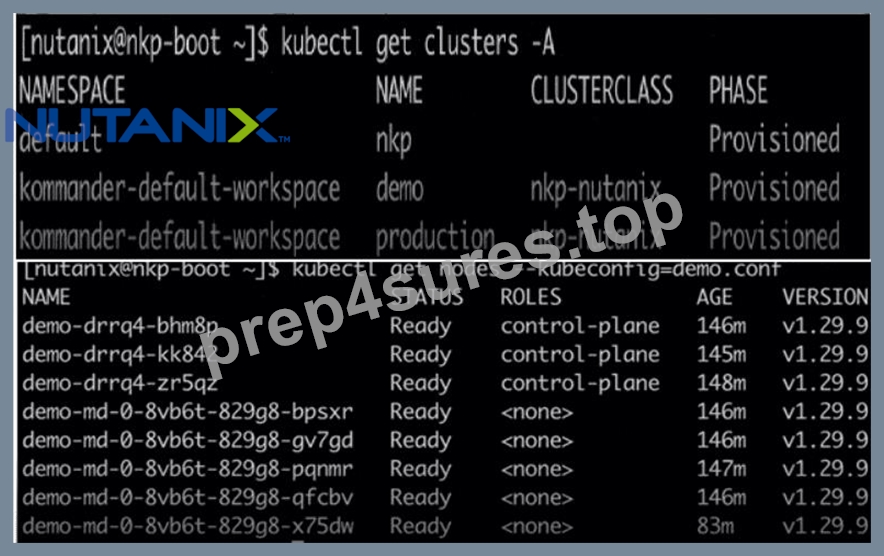
How should the demo cluster be properly deleted?
- A. Run nkp delete cluster -c demo -n kommander-default-workspace
- B. Run kubectl config delete-cluster demo -n kommander-default-workspace and delete the VMs.
- C. Run acli vm.delete demo* from a CVM.
- D. Delete all the VMs and inform of the results.
Answer: A
NEW QUESTION # 36
A company has a new DevOps team that needs to be provided cloud native computing resources. This team will need to have access to multiple NKP clusters for development, testing and validation of an in-house application. However, they also need to be restricted to a specific namespace and a consistent level of access across the clusters within this namespace so that they do not adversely impact the environment of other user groups or the clusters themselves.
As a part of this consideration, the new team also needs to be limited to the amount of storage, CPU and memory they can consume on the clusters. A Platform Engineer has been tasked with providing the appropriate level of access to the team on these multiple NKP clusters.
How should the engineer best accomplish this task?
- A. 1.Create an NKP workspace and assign the NKP clusters to it.2.Create quotas for the NKP workspace.3.Create an NKP group for the DevOps team.4.Assign that NKP group the proper RBAC roles within that NKP workspace.
- B. 1.Create an NKP project and assign the NKP clusters to it.2.Create quotas for the NKP project.3.Create an NKP group for the DevOps team.4.Assign that NKP group the proper RBAC roles within that NKP project.
- C. 1.Enable Gatekeeper on the NKP clusters.2.Create an NKP group for the DevOps team.3.Assign Gatekeeper quota and authorization policies to that NKP group.
- D. 1.Create an NKP group for the DevOps team.2.Assign that NKP group the proper RBAC roles in the NKP UI.3.Select the export to yaml option once the RBAC role assignment to that NKP group is complete.4.Apply the exported manifest to each of the NKP clusters using kubectl.
Answer: D
NEW QUESTION # 37
Using an NKP Ultimate license, a Platform Engineer has created a new workspace and needs to create a new Kubernetes cluster within this workspace. However, the engineer discovers that the Create Cluster option is grayed out, as shown in the exhibit. How should the engineer resolve this issue?
- A. Ensure NKP is upgraded to a minimum version of 2.12.
- B. Create the cluster only using YAML and not the GUI.
- C. Attach existing clusters instead of creating a new cluster.
- D. Create an Infrastructure provider for the workspace.
Answer: D
NEW QUESTION # 38
A Platform Engineer is going to deploy NKP to a Nutanix cluster on-prem as well as Amazon EKS. What is the function of the bootstrap cluster for this architecture?
- A. Increases security from a single point of entry.
- B. Saves cost by minimizing resources required for provisioning.
- C. Simplifies the networking requirements for Kubernetes.
- D. Uses Cluster API for infrastructure-agnostic provisioning.
Answer: D
NEW QUESTION # 39
A Kubernetes administrator needs to ensure that the following requirements are met whenever a new workload cluster is deployed to a workspace:
Grafana Logging
Grafana Loki
Project LoggingHow would the administrator ensure that these components are deployed as part of a cluster deployment?
- A. Enable them in the Insights section under workspace.
- B. Enable them in the Projects section under workspace.
- C. Enable them in the Clusters section under workspace.
- D. Enable them in the Application section under workspace.
Answer: D
NEW QUESTION # 40
A Cloud Engineer manages an NKP environment and is preparing a machine image to become an NKP cluster node.
Which statement is regarding the default node preparation process?
- A. Shell scripts are used to harden the OS image for use as an NKP node.
- B. Goss is used to make the OS image CAPI compliant for use as an NKP node.
- C. Ansible is used to validate the OS image is capable of running NKP.
- D. Goss is used to validate the OS image is capable of running NKP.
Answer: D
NEW QUESTION # 41
When deploying an NKP cluster onto air-gapped, pre-provisioned servers, Konvoy Image Builder is utilized to prepare the servers to become NKP cluster nodes.
What does the konvoy-image upload command do as a part of this preparation process?
- A. The command is used to upload OS hardening scripts to the server (must be client supplied).
- B. The command uploads artifacts to the servers such as the container runtime, the OS bundle, and Kubernetes components.
- C. The command uploads artifacts to the servers such as the container runtime, the OS bundle, and Kubernetes components, including optional OS hardening scripts (must be client supplied).
- D. The command is used to create a konvoy userid on the servers, as well as upload artifacts to them such as the container runtime, the OS bundle, and Kubernetes components.
Answer: B
NEW QUESTION # 42
A Platform Engineer is preparing an AWS instance using KIB for becoming an NKP cluster node. During the process, the source AMI is successfully cloned, and multiple preparation steps have occurred against the cloned AMI, such as gathering OS-release facts and uploading image bundles to it. However, the process encounters an error and ultimately fails. What is one troubleshooting step the engineer can perform that may help identify the root cause of the issue?
- A. Rerun the KIB command, including the parameter to instruct Ansible not to automatically delete the cloned AMI on error. This way the OS image can be accessed and further inspected.
- B. Rerun the KIB command, including the parameter to instruct Packer not to automatically delete the cloned AMI on error. This way the OS image can be accessed and further inspected.
- C. Rerun the KIB command, including the pause parameter, so that each command in the KIB-prep sequence and its return can be reviewed in detail before allowing the prep process to continue.
- D. Rerun the KIB command, including the parameter to set the verbosity level to debug, so that all issued AWS CLI commands and their returns are included and added to an exported log file for review.
Answer: D
NEW QUESTION # 43
A Platform Engineer for an organization does research in Antarctic
a. The engineer is preparing a bastion host for deploying NKP while the infrastructure is isolated. Which programs should the engineer ensure are installed on a bastion host before shipping the infrastructure?
- A. kubectl and nkp
- B. oc and az
- C. oc and kubectl
- D. awscli and nkp
Answer: A
NEW QUESTION # 44
In a telecom company, two teams were working on the development of two different applications:
ApplicationA
ApplicationBApplicationA's development team was excited about the release of their new functionality. However, upon deploying their application, they noticed that performance was slow. After investigating, they discovered that the ApplicationB team was consuming the majority of the cluster's resources, affecting all other teams. How can this problem be mitigated?
- A. Configuring RBAC
- B. Implementing Quotas and Limit Ranges
- C. Implementing Continuous Deployment (CD)
- D. Setting up Network Policies
Answer: B
NEW QUESTION # 45
A company has standardized on NKP for their Kubernetes platform and needs to deploy their first cluster with the following requirements:
Dark site ready
Custom Service CIDR Block
Custom Pod CIDR Block
Hosted on Nutanix AHV ClusterWhich tool would the administrator use to perform the deployment?
- A. kubectl CLI
- B. NKP CLI
- C. NKP GUI
- D. OCP CLI
Answer: B
NEW QUESTION # 46 
The cluster arca will host a new application that needs to add more workers. The company cannot get more NKP licenses, so it has decided to delete the demo cluster and add the required workers to the arca cluster. How should the engineer delete the demo cluster from this UI?
- A. Press the ("demo" cluster line) three-dot menu at the right and select Detach. Then ask the cluster owner to delete the cluster.
- B. Login with SSH to the kommander cluster and execute kubectl delete cluster -c demo
- C. Press the ("demo" cluster line) three-dot menu at the right and select Download kubeconfig, then use that file to execute kubectl delete cluster -c demo --kubeconfig=demo.conf
- D. Press the ("demo" cluster line) three-dot menu at the right and select Delete.
Answer: D
NEW QUESTION # 47
An ecommerce company decides to apply an autoscaling configuration in its NKP cluster due to the fact that on holidays, they experience service drops due to a huge increase of simultaneous traffic.
Which statement best describes the configuration shown in the exhibit?
- A. The autoscaler could increase the number of nodes as needed, but never reduce it below 3.
- B. The autoscaler could increase the number of nodes up to 15, but never reduce the number below 3.
- C. The autoscaler could have 15 or 3 nodes.
- D. The autoscaler could increase the number of nodes up to 3, but never reduce it below 15.
Answer: B
NEW QUESTION # 48
A Platform Engineer has deployed NKP and wants to utilize its OOB data storage feature.
What should the engineer enable to support backups within the NKP environment?
- A. Rook Ceph
- B. Objects S3
- C. Volumes iSCSI
- D. MinIO
Answer: A
NEW QUESTION # 49
A Platform Engineer has been tasked with building a custom image for the deployment of NKP management and worker nodes. The engineer needs to ensure that the proper package versions are used when creating these images. The security team has only authorized version 1.30.5 of Kubernetes and version 1.7.22 of containerd. Where should the engineer go to verify that this is the version being used when building the custom image?
- A. ansible/group_vars/all/defaults.yaml
- B. terraform/vars/default/terraform.tfvars
- C. The custom image's .env file
- D. config/pulumi/vars/pulumi.kib.config
Answer: A
NEW QUESTION # 50
......
Online Exam Practice Tests with detailed explanations!: https://realdumps.prep4sures.top/NCP-CN-real-sheets.html